

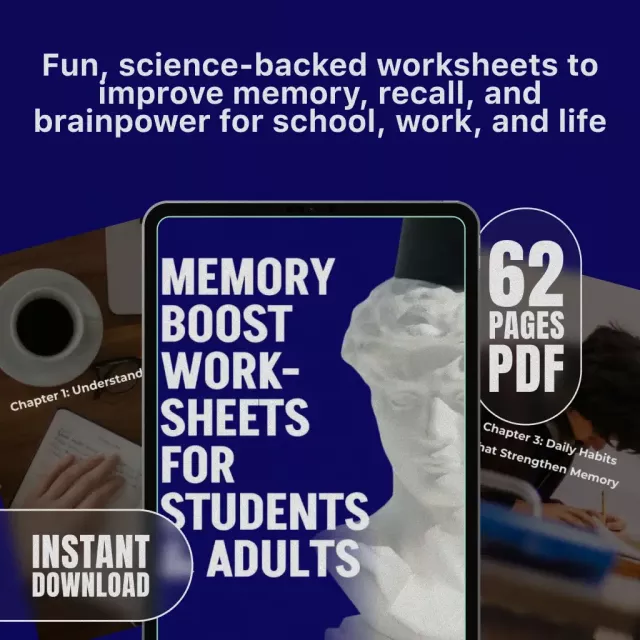
Remembering names, lectures, formulas, meetings, and to-dos often comes down to having a repeatable practice—not just “trying harder.” Memory Boost Worksheets for Students & Adults is a printable and digital download set designed to turn proven memory techniques into guided exercises that fit real schedules. It can be used for school study sessions, professional upskilling, or everyday recall training, with prompts that encourage active retrieval, structured review, and clearer encoding of new information.
These pages are built around the kinds of memory problems that show up in real life: information that felt clear yesterday but disappears when you need it most. Used consistently, the worksheets support:
These approaches align with widely recommended memory habits such as staying mentally active, using organizational tools, and practicing strategies that improve recall over time (see National Institute on Aging and the American Psychological Association for practical, research-informed guidance).
The download is designed to feel like a guided “practice kit” rather than a stack of blank pages. It includes:
If you want the full set, you can find it here: Memory Boost Worksheets for Students & Adults (Printable Digital Download).
The fastest way to get value from memory worksheets is to treat them as a short routine instead of an occasional “extra.” This sequence keeps sessions compact while still strengthening recall:
That last step matters more than it seems: the “forgotten list” becomes your personal syllabus of what deserves another pass—so time is spent where it actually moves the needle.
Some learners remember best with pen and paper; others need a device-first workflow. The most reliable choice is the one you’ll repeat without friction.
| Option | Best for | Tips to get results faster |
|---|---|---|
| Printable worksheets | Handwriting-based learners, focused practice, quick desk sessions | Use a timer (10–15 min) and do recall before checking notes |
| Digital worksheets (tablet/laptop) | On-the-go study, easy duplication, storing topics and review logs | Duplicate a template per topic and track spaced-review dates |
| Hybrid (print + digital) | Students and adults managing multiple subjects or projects | Print recall drills, keep a digital index of what to review next |
A hybrid approach often performs best: print the pages that you want to feel “exam-like,” then keep digital copies for topic lists, review calendars, and quick duplication. For classrooms or households, printing a small weekly packet can keep practice consistent even as subjects change.
The worksheets make it easier to stick with techniques that are simple in theory, but easy to skip when time is tight:
To support your memory practice with an easy lifestyle companion, pair study routines with steady meals and fewer skipped lunches—planning removes daily decision friction. If that helps, consider adding Healthy Meal Plan & Recipe Collection to your weekly reset.
Small improvements often show up within 1–2 weeks when you use active recall and spaced review consistently. Aim for 10–15 minutes per day and track what you missed so the next session targets the right weak spots.
They work for both: students typically use them for exam recall and unit reviews, while adults use them for training, meetings, and daily information retention. The simplest tailoring is to adjust the prompts—students focus on practice questions, adults add real-world “use it tomorrow” examples.
Yes—keep a digital master for duplication and tablet annotation, and print selected pages when you want distraction-free recall drills. Many learners find a hybrid setup makes it easier to stay consistent across different settings.







Leave a comment