

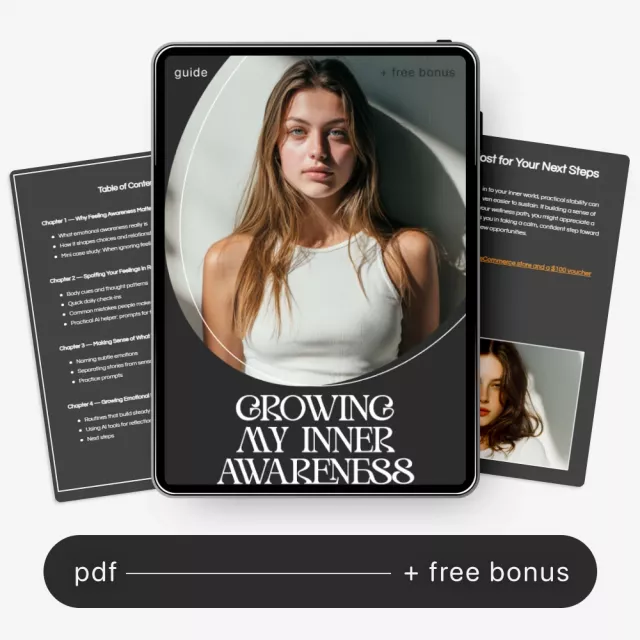
Emotional awareness is a skill that can be practiced: noticing what is felt, naming it accurately, understanding what triggered it, and choosing a response that matches personal values. Growing My Inner Awareness – Emotional Awareness Guide & Self Reflection eBook (Digital Download) is a digital guide designed to make that practice simple and repeatable, combining mindfulness-based check-ins, emotional intelligence building blocks, and guided reflection with optional AI-assisted questions for deeper journaling.
The goal isn’t to “fix” emotions. It’s to build a steady inner signal system—so feelings become useful information instead of sudden storms that run the day.
Inner awareness is practical. It shows up in ordinary moments—before an email reply becomes sharp, before a conversation turns defensive, or before a stressful week becomes burnout.
That pause is where choice lives. Even a few seconds can be enough to respond in a way that aligns with the person you want to be.
This eBook is built for repeat use. Instead of long, open-ended journaling sessions, it offers small “check-in loops” that can fit into real schedules.
| Tool | Best for | Try it when | Typical time |
|---|---|---|---|
| Body scan check-in | Noticing signals before thoughts spiral | Emotions feel confusing or sudden | 2–5 minutes |
| Emotion labeling | Reducing overwhelm by adding clarity | Everything feels like “stress” or “anger” | 2–3 minutes |
| Trigger mapping | Finding repeating situations and themes | The same conflict keeps happening | 5–10 minutes |
| Values-based next step | Turning insight into a calm action | Feeling stuck after journaling | 3–7 minutes |
| AI-assisted reflection questions | Generating prompts and perspectives for journaling | Words won’t come or thoughts feel scattered | 5–15 minutes |
For readers who like a simple way to track habits and timed resets, a device such as the Rugged AMOLED Smartwatch with 3D Curved Display & Bluetooth Calling can help support short check-ins (like a 3-minute body scan or a 10-minute daily reflection) without needing to pick up a phone mid-routine.
Consistency matters more than intensity. This one-week routine is designed to build momentum while keeping the daily effort realistic.
When the space around you supports your intention, the routine gets easier to repeat. Something as simple as a calm focal point—like the Golden Abstract Human Body Resin Sculpture on a desk or shelf—can act as a visual cue: “Pause. Notice. Choose.”
AI-assisted questions work best as a brainstorming partner, not a decision-maker. The purpose is to widen perspective and help language emerge—while keeping the reflection grounded in lived reality.
For a research-aligned foundation on the core skills behind the practices, the American Psychological Association’s overview of mindfulness and Greater Good Magazine’s definition of emotional intelligence offer helpful context.
After purchasing Growing My Inner Awareness, the best first step is making the practice easy to begin—even on a busy day.
For additional support on practical coping skills, the National Institute of Mental Health resource on coping with stress is a strong starting point.
Yes. It’s built around step-by-step prompts and short check-ins that reduce the blank-page problem, so it’s easy to start with just 5–10 minutes and build consistency from there.
They’re optional support for generating angles, language, and perspective when thoughts feel stuck. Use them to explore possibilities, then choose what matches your values and your real-life context.
Mindfulness focuses on attention skills—slowing down to notice sensations, thoughts, and emotions as they arise. Emotional intelligence focuses on working with those emotions—naming them accurately, understanding patterns, communicating needs, and choosing responses on purpose.











Leave a comment